


Businesses operating a seismic exploration, ROV, or defense operation in today’s difficult economic and regulatory environment must work to stretch the lifetime of undersea cables to their maximum lifetime. This blog series presents a 5-step plan for inspecting cables, along with some tips for general handling to help you make the most of your equipment:
- General Handling Advice: Storing and Unpacking
- General Handling Advice: Reeling, Installation and Deployment
- When should you call DeRegt?
This blog will cover essential handling instructions during reeling, winch installation, and deployment of cables to help prevent any kind of damage and extend the lifetime of your investment.
General handling during reeling and deployment
To avoid damaging cable connectors, make sure to use the strength element for pulling and not the electrical or optical pigtails.
The cable should never be subjected to a bend radius smaller than the minimum recommended radius (see manufacturer’s instructions). During extreme bending the inner-bedding sheath, outer sheath and subcomponents of the cable will be severely stressed and may be damaged.
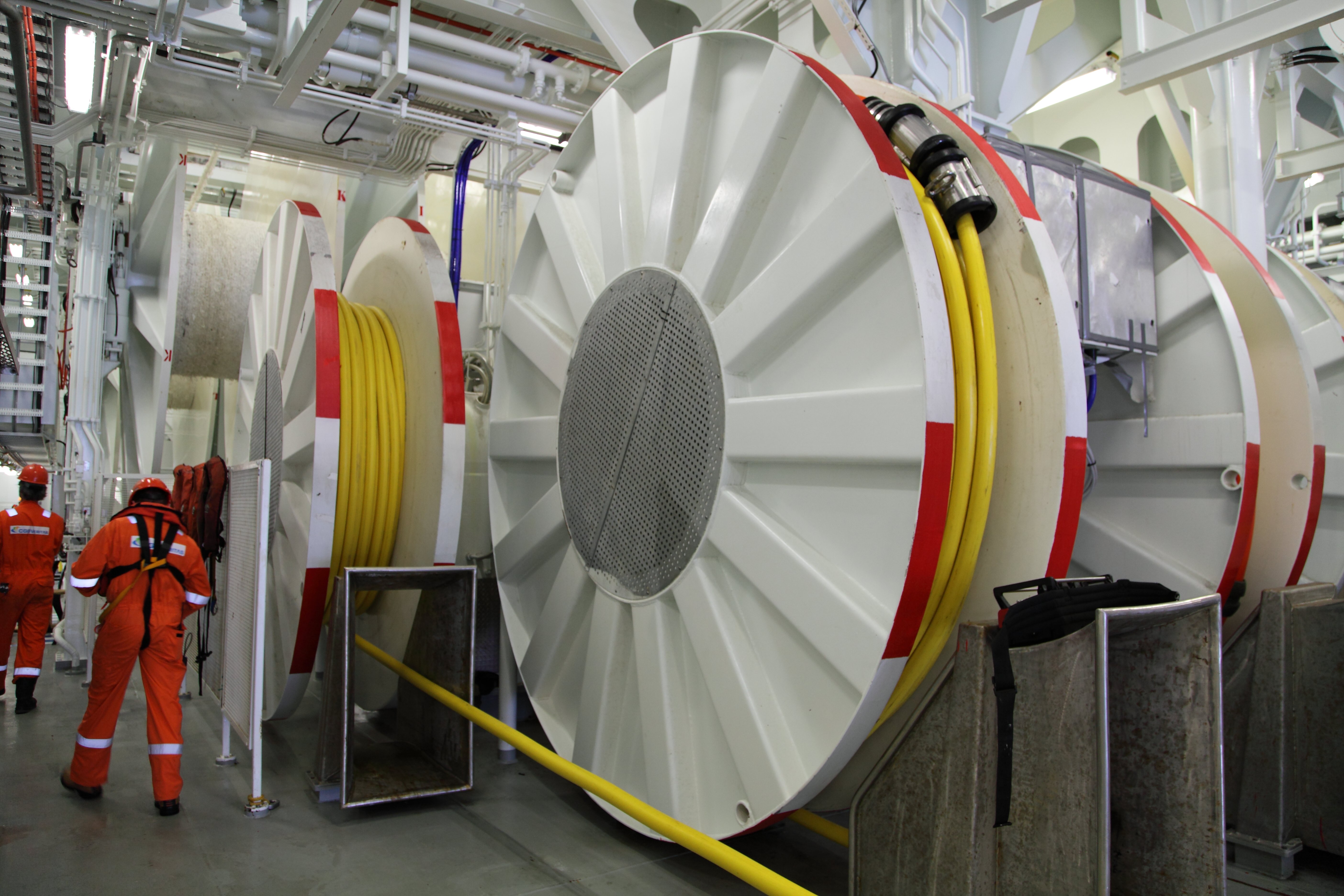
Winch Installation
Cable installation on a winch has three major goals:
- To resist crushing from succeeding layers,
- To provide good structural support to the following layer, and
- To minimize/eliminate cable slip during deployment.
When reeling the cable onto winches or drums it’s important that the cable is evenly wound with no gaps between coils and no riding coils (crossovers). Gaps must be avoided so that coils on succeeding layers are fully supported and prevented from nestling down (key-seating) into the layer below. Riding coils could result in the cable being crushed or damaged by surrounding layers when it is under tension self-weight.
Steel-armored cables (and torsionally stiff cables) should be maintained under tension at all times. Residual torsion may be stored even in torque balanced cables that have been pre-stressed or wound and this residual torsion may cause the cable to throw a loop.
Loops or kinks cannot be allowed to form, because as the cable is pulled the loops will reduce in size until the cable bends to such a sharp angle that it cannot recover. The cable must be kept straight without twists or loops from the shipping drum to the winch drum before the winding operation starts.
Careful handling preserves your investment
The best way to prevent downtime and high costs for your marine cables is to follow your manufacturer’s instructions for safe handling. Working together with your supplier in an early stage of cable design and development will pay off, as choices made in the beginning can significantly impact the system. Together we will ensure your marine cable equipment remains operational during its full lifetime, saving you time and money in the long run.
For more practical tips from our experts in the field on the best ways to handle source umbilicals and lead-in cables, download the free DeRegt Seismic Guide on Cable Handling: